CodeWords Cryptogram Puzzles
QuriousBit GamesWord
4.6208.00 Reviews
- Version
- 1.138.0
- Installs
- 100.00K
- Age Rating
- Everyone
Screenshots
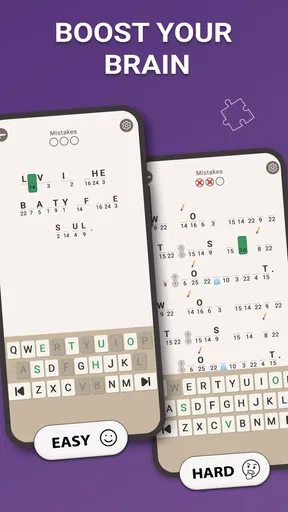
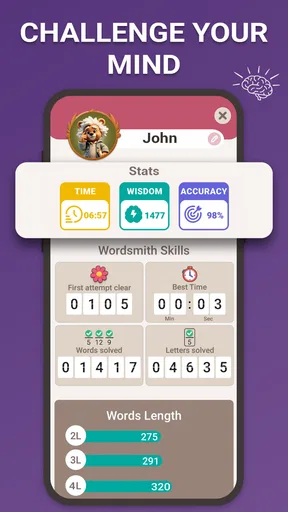
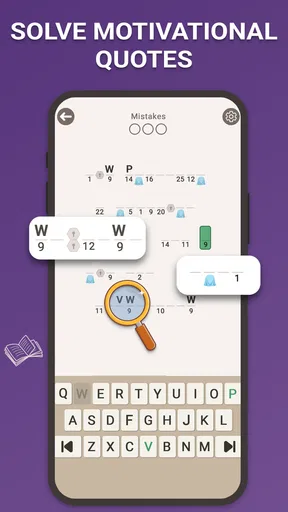
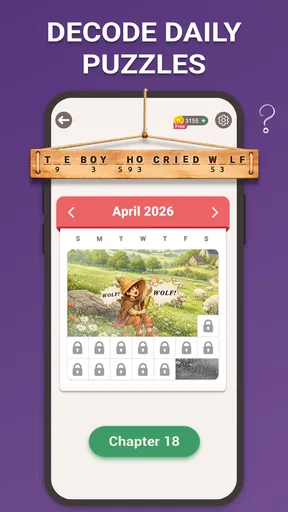
Our Review of CodeWords Cryptogram Puzzles
 Analysis by Appyee
I went into CodeWords Cryptogram Puzzles expecting a familiar word game: a quotation on screen, a few substituted letters, and the usual cycle of guessing until something clicks. That basic idea is exactly what it offers, but the appeal comes from how it turns a quiet decoding task into a small daily ritual. I found myself playing in short bursts rather than settling in for one long session, which suits the game’s thoughtful pace and makes it easy to fit into a commute, a coffee break, or the last few minutes before bed.
Created by QuriousBit Games, this free word game focuses on cryptograms, word puzzles, and hidden messages. It is rated for Everyone, so the concept is approachable for a broad audience, while the actual challenge depends more on language familiarity and patience than on age. The game has built a 4.6 average from around 5.1 thousand ratings and has passed 100 thousand installs, which gives it the feel of an established niche puzzle rather than an untested experiment.
My first impression: a calm puzzle with a deliberate pace
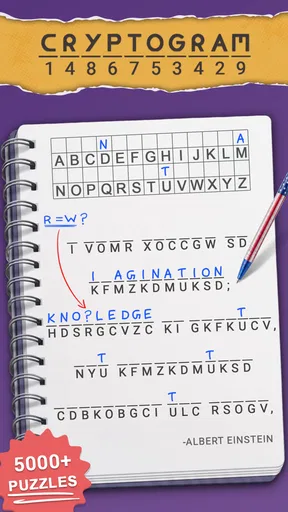
The first thing I noticed was that the game does not need a complicated premise to create curiosity. A coded sentence is enough. You see a message that looks almost readable, then start searching for repeated patterns, likely short words, and familiar letter combinations. That gradual movement from confusion to recognition is the central pleasure, and the game wisely keeps its attention on that process.
What makes the opening experience work is its restraint. This is not a word game built around frantic timers, noisy competition, or constant visual interruption. The setting is essentially the puzzle itself, and that gives the act of decoding a private, almost bookish mood. I could pause halfway through a message and return later without feeling that I had lost the thread completely.
That slower approach will not suit everyone. If you want a word game that rewards rapid taps, quick rounds, or visible competition, this may feel understated. Its satisfaction arrives through deduction, not speed. I would recommend it first to people who enjoy crosswords, logic puzzles, quote puzzles, or the moment when a difficult clue suddenly becomes obvious.
The free entry point is useful because it lets you test that rhythm without committing money at the start. The game includes in-app purchases ranging from $0.99 to $199.99 per item, so I would advise checking the purchase flow carefully before treating it as a completely cost-free long-term hobby. The game can be downloaded without paying, but the presence of optional purchases is still part of the practical decision for families and anyone who prefers tightly controlled spending.
A visual language built around decoding
The most important visual choice is functional rather than decorative: the letters and their relationships have to remain easy to inspect. In a cryptogram, a repeated symbol or word pattern can be the clue that unlocks the whole sentence. If the screen makes those details hard to read, the puzzle becomes frustrating for the wrong reason. Here, I found the experience strongest when I treated the display as a working surface rather than as a backdrop.
That distinction matters. Some word games use bright rewards, animated celebrations, and elaborate themes to keep attention moving. This one gets much of its character from the contrast between a concealed message and the player’s growing understanding. The “world” is made from language: fragments, patterns, likely meanings, and the visual tension between coded text and solved text.
I also think this presentation helps the game remain approachable. You do not need to learn a fictional universe or understand a story before beginning. The puzzle explains itself through the problem in front of you. That makes it a good choice for someone who wants a focused mental activity rather than a narrative game with a large amount of setup.
There is a trade-off, though. Because the appeal depends so heavily on reading and pattern recognition, the experience may become less comfortable if you are tired, using a smaller screen, or playing in poor lighting. I found that a relaxed posture and a little uninterrupted attention made a noticeable difference. This is not the kind of game I would choose while multitasking heavily, because a single missed repetition can send the deduction in the wrong direction.
The hidden-message mood
The game’s strongest atmosphere comes from the idea that ordinary language is temporarily locked away. A sentence is present, but it refuses to communicate until you understand its internal code. That creates a gentle mystery without needing dramatic storytelling. I enjoyed the feeling of investigating a message rather than simply filling boxes in a grid.
One useful way to approach each puzzle is to separate recognition from interpretation. First, I look for structural clues: very short words, repeated groups, and letters that appear in several positions. Only after that do I think about what the sentence might mean. Starting with the theme or guessing a famous phrase can sometimes help, but it can also make me force the wrong letters into place. The game rewards a more disciplined habit than random guessing.
That is one of the less obvious strengths here: it encourages you to think about language as a system. You begin noticing how common words are shaped, how endings recur, and how one correct substitution can clarify several parts of a message at once. The result feels closer to a compact logic exercise than to a simple vocabulary test.
It also means that language background matters. Players who regularly read English will probably find the clues more natural than players still building confidence with English words and sentence structures. The Everyone rating describes the broad accessibility of the content, but it does not remove the language barrier that is built into any cryptogram game. For younger players, it can be a useful shared activity with an adult, especially when the adult explains why a pattern is persuasive instead of simply supplying the answer.
Sound, rhythm, and the feel of a session
The game’s mood is defined more by concentration than by spectacle. I approached it as a quiet activity, and that is where it made the most sense to me. The lack of pressure lets each puzzle breathe: inspect the message, try a theory, revise it, and continue when the structure becomes clearer. That rhythm is important because cryptograms can lose their charm when a game pushes the player to hurry.
Rather than judging the experience by how much audio or animation it provides, I think it is better to ask whether the presentation supports thought. In my sessions, the answer was generally yes. The game’s identity comes from the pause between guesses and the small mental reward of confirming a pattern. It feels more like solving a page of puzzles than attending an arcade show.
This makes it especially suitable for a few specific routines. I can imagine using it during a short break when I want something more active than scrolling but less demanding than a full game. It also works well as a wind-down activity because the objective is clear and the pace is self-directed. I would avoid playing it when I need constant stimulation, since the quiet intervals that make it relaxing may feel slow in that situation.
A practical tip is to stop before frustration turns into blind guessing. When I reached a point where every new letter seemed equally plausible, taking a break was more useful than repeatedly tapping alternatives. Returning with fresh attention often made the repeated patterns easier to see. That is a small but important difference from many casual puzzle games: progress depends not only on persistence, but also on knowing when your concentration has flattened out.
Why the pacing works for some players and not others
The pacing is forgiving, but forgiving does not mean effortless. A puzzle can be calm while still demanding careful reasoning. I liked that balance because it gave the sessions a sense of progress without making them feel like a test. The game is at its best when I have enough time to form a hypothesis and check it against the rest of the message.
Players who prefer instant feedback may find the process less rewarding. In a match-three game, a move can produce a visible chain reaction in seconds. In a cryptogram, the payoff may come only after several related deductions. That makes CodeWords a poor substitute for fast casual games, but a strong alternative to them when I want my attention to settle on one problem.
The pacing also affects how I compare it with traditional alternatives. A newspaper cryptogram gives you the tactile pleasure of paper and often encourages a longer session. A crossword offers broader clue variety and a grid-based sense of progress. A standard word-search game is usually easier to enter and less dependent on sentence comprehension. This game sits between those options: it has the focused decoding of a cryptogram, the language element of a quote puzzle, and the convenience of a phone-based activity.
That convenience is its clearest advantage over paper. I can keep it available for an unplanned spare moment, and I do not need a pencil or a printed puzzle. The trade-off is that a phone can bring distractions with it, and the digital format does not provide the same physical sense of marking a page. If the ritual of paper solving is part of what you love, this will feel different even when the underlying deduction is familiar.
How the mechanics support the atmosphere
The central mechanic and the mood are closely matched. Decoding a substituted message naturally creates a measured loop: observe, infer, test, and correct. The game does not need to add artificial drama because the uncertainty is already inside the sentence. Every repeated pattern carries information, and every confirmed letter can change the meaning of several other words.
For new players, my best advice is to begin with the shortest visible words and repeated sequences, but not to treat the first guess as fact. A two-letter word may be common, yet context still matters. I also look for a symbol that appears in several different word positions. If it seems to behave like a frequent vowel or consonant, I test that idea against the entire message rather than celebrating one match.
A second useful habit is to keep track of contradictions. If one proposed substitution makes a familiar-looking word impossible elsewhere, I treat that as evidence against the proposal. This prevents the most common cryptogram mistake: becoming attached to a clever guess simply because it worked once. The game is more enjoyable when I let the whole message judge each individual assumption.
A third tip is to read the emerging sentence aloud in my head once enough letters are visible. Sound and grammar can reveal where a word is likely heading, but I use that late in the process. Starting from imagined phrasing can make me overlook the actual pattern. The strongest workflow is structural first, contextual second.
These habits show why the game has more depth than its short store summary suggests. It is not merely about replacing symbols until words appear. It teaches a compact method of reasoning that can be satisfying even when the final message is less interesting than the path used to uncover it.
Everyday use, accessibility, and the purchase question
In an everyday scenario, I would use this during a ten-minute wait when I want a clear stopping point. I can begin a puzzle, make a few deductions, and put the phone away without needing to remember a complicated story or manage a long inventory. If I have more time, I can continue until the message resolves. That flexibility is one of the game’s most practical strengths.
The Everyone content rating also makes it easier to recommend as a family-friendly word activity. Still, I would not assume that every child will find it easy. Reading ability, vocabulary, and comfort with indirect clues matter more here than reflexes. It can work well for a parent and child solving together, with the adult modeling how to test a theory instead of guessing at random.
The current version is 1.138.0, and the game requires at least iOS 11 or a later compatible operating system. That requirement is worth checking before downloading, particularly if the game is intended for an older device. On a supported phone, the main consideration is not hardware performance but whether the screen and text are comfortable for sustained reading.
The purchase range deserves a measured response. Free access makes experimentation easy, but a listed upper purchase point of $199.99 per item is substantial. I would use device-level purchase protections, especially on a shared phone or a child’s device, and I would look at what each optional purchase provides before spending. For someone who wants a completely predictable one-time cost, a paid crossword collection or paper puzzle book may be a better fit.
Who should choose it—and who should skip it
I would recommend this game to readers who enjoy wordplay, cryptic patterns, quotations, and quiet problem-solving. It is particularly well suited to people who like puzzles that can be paused without penalty and resumed without a lengthy tutorial. It also suits anyone trying to replace passive phone scrolling with something that gives the mind a specific task.
I would be more cautious about recommending it to players who need constant novelty, competitive rankings, rapid rounds, or a strong story setting. Someone who finds language puzzles intimidating may also prefer a word-search or anagram game first. Those alternatives usually offer more immediate recognition and less dependence on sentence-level meaning.
Compared with a traditional cryptogram book, the phone version is more portable and easier to keep within reach, but it may feel less personal. Compared with a crossword app, it narrows the focus to substitution and hidden messages rather than mixing clues across a grid. Compared with quick word games, it asks for more patience and rewards deeper attention. None of those differences is automatically a flaw; they simply define the audience more clearly.
My final atmosphere verdict
CodeWords Cryptogram Puzzles succeeds because its presentation, pacing, and main mechanic point in the same direction. The coded messages create the setting, the restrained rhythm gives the player room to think, and the act of decoding supplies its own sense of drama. I never felt that the atmosphere was being pasted on top of the puzzle. The mood grows naturally from the work of uncovering meaning.
My main reservation is that this focused calm can become slow if I am looking for quick entertainment. The language requirement can also make the game less welcoming for players who are not comfortable reading English, and the optional purchase range means I would approach spending with care. Those are real considerations, not minor footnotes.
Even so, I think the game is a good recommendation for the right person. It offers a free way into a thoughtful word-puzzle format, carries an Everyone rating, and has already attracted over 100 thousand installs. I would choose it over a standard word-search when I want deduction rather than repetition, and over a fast arcade-style word game when I want my attention to slow down.
If you enjoy the moment when a scrambled message suddenly becomes obvious, this is worth trying. Its best feature is not speed or spectacle, but the satisfying connection between every correct guess and the sentence gradually revealing itself. That makes it a modest, focused game, yet one with a surprisingly coherent personality.
Verdict
Strengths of CodeWords Cryptogram Puzzles
- Large collection of cryptogram puzzles for regular play
- Simple interface makes clues easy to read and enter
- Helpful hints can assist when a puzzle becomes difficult
- Suitable for short sessions or longer puzzle-solving breaks
- Improves pattern recognition and vocabulary through wordplay
Limitations of CodeWords Cryptogram Puzzles
- Some puzzles may feel repetitive after extended play
- Hints can reduce the challenge for experienced solvers
- Difficulty may vary noticeably between individual puzzles
- Requires patience if you are unfamiliar with cryptograms
- Ads or in-app purchases may interrupt the playing experience
Similar Picks in This Category
View All
Word Search - Word Puzzle Game
Bluetile4.8

Word Search Quest - Puzzles
Blackout Lab4.8

CodyCross: Crossword Puzzles
Fanatee, Inc.4.7

Words of Wonders: Crossword
Fugo Games4.9

Wordscapes: Word puzzle game
PeopleFun4.7

Word Search Explorer
PlaySimple Games4.9
Frequently Asked Questions
What is CodeWords Cryptogram Puzzles?
CodeWords Cryptogram Puzzles is a word puzzle game based on the classic codeword format. Instead of giving you a traditional crossword clue for every answer, the game provides a grid containing numbers that represent letters. Your goal is to identify the hidden words by solving the letter code and completing the entire puzzle. It is designed for players who enjoy vocabulary, logic, and deduction challenges.
How do you play CodeWords Cryptogram Puzzles?
Each puzzle uses numbers in place of letters, with the same number always representing the same letter throughout the grid. You begin by studying the available patterns, entering likely letters, and using repeated combinations to uncover words. As more letters are solved, the remaining answers become easier to recognize. The game generally rewards careful deduction rather than fast reflexes, making it suitable for relaxed, thoughtful play.
Is CodeWords Cryptogram Puzzles suitable for beginners?
Yes, the game can be suitable for beginners, although the first few puzzles may require patience if you are unfamiliar with codeword puzzles. Early challenges help you understand how number-to-letter relationships work, while hints or assistance features may help when you get stuck. Players with stronger vocabulary skills may progress more quickly, but the format is still approachable for casual puzzle fans.
Does CodeWords Cryptogram Puzzles require an internet connection?
The core puzzle experience may be playable without a constant internet connection, which is convenient for commuting, traveling, or playing in areas with limited service. However, some features can depend on connectivity, including advertisements, synchronization, updates, analytics, or optional online content. Before downloading, it is worth checking the current store listing because offline availability and online requirements can change between app versions.
Is CodeWords Cryptogram Puzzles free to download?
CodeWords Cryptogram Puzzles may be available as a free download, but the exact monetization model can include advertising, optional purchases, or paid features such as extra hints and ad removal. The free version should be checked carefully for the frequency of advertisements and any content limitations. Review the Google Play or App Store listing before installing so you understand possible costs and in-app purchase conditions.
Play our best games!


